Friday, October 25, 2013

Capricious blogging germane to my avocations


I have constantly heard that the best way to remember new words is to actually use them, no matter what language you are speaking in. Therefore, in this post I will attempt to appropriately incorporate as many of our AP English vocabulary words into my post as possible. If you do not understand or remember some of the words I use, appropriate definitions may be found on the interwebs.

First of all, let me introduce the story that I will be talking about today: Mirai Nikki (Future Diary.)
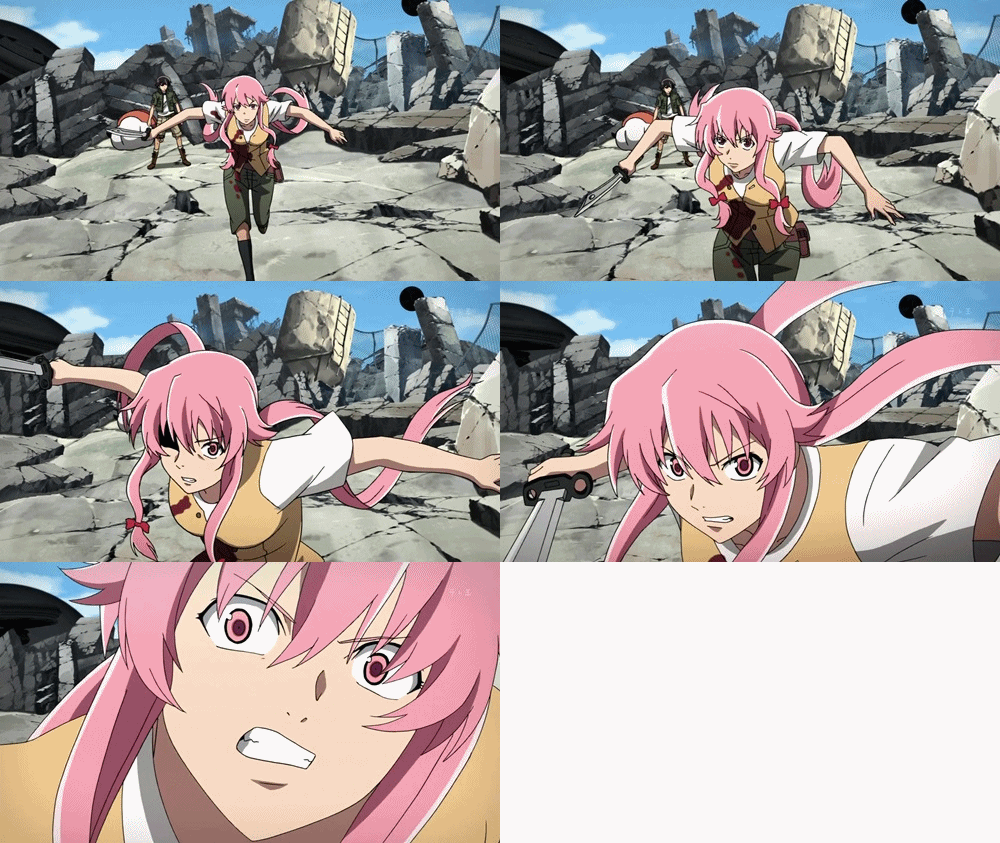
Mirai Nikki is a relatively dark Japanese animated series, with the reticent main male protagonist Yukiteru Amano and the awesome (in my opinion) main female protagonist, Yuno Gasai, who is an inexorable stalker of Yuki. She does this with ardor.

http://kawaii-mobile.com/2012/06/mirai-nikki/mirai-nikki-yuno-gasai-yukiteru-amano-320x480-3/
The plot basically boils down to this: There are twelve people in the story, Yuki and Yuno included, who each have an avocation of writing in a diary of some form (phone, book, etc.) Suddenly one day, their diaries receive the power to predict the future, each in a different way (i.e.- Yuki's predicts random events that he would have recorded himself, and Yuno's predicts anything that Yuki does, since she is obsessed with him.) This power was bestowed by Deus, the God of Time and Space, whose lifespan was coming to an end. He looks more and more moribund later in the series, as parts of his face and machine-like body start falling off. In order to save the universe from complete destruction, a new God of Time and Space had to be chosen before his death.
Probably after musing for a some time, he decided that the last survivor out of the twelve chosen people would succeed him as God - in short, the twelve were pitted in a battle-royal against each other without knowing each other's identity.

Yuno is generally revealed to be, to put it bluntly, insane. There is a huge disparity between how one would expect a typical pretty high school girl to act and how she acts. She enjoys slaughtering anybody who acts licentiously around Yuki or otherwise endangers him. Her eyes often turn vacuous and her face is covered in shadows when she enters this "insane" mode. Her love for him is genuine though, albeit in a twisted kind of way - she would willingly risk her own neck to save hers. Many times, Yuki's plight was reversed because of Yuno's quick action and steady hand of slaughter (She goes on a huge killing spree throughout the series. She kills more people than even all the other participants of the game combined, I believe.) Her personality, however, led her one time to presumptuously capture Yuki in order to eliminate the possibility of the other participants of the game killing him. Yuno's impetus for killing is presumably to save Yuki. Later on, Yuki's impetus for becoming God is to bring his parents back to life after they were both killed.

http://www.hexieshe.com/634738/

Thursday, October 17, 2013

Spicy Wolf


http://nopybot.com/2009/10/18/spice-and-wolf-ii-review/
Spice and Wolf is an anime series with 2 seasons, based off of the light novel written by Isuna Hasekura. It's set in a time when humans still used horses to travel, and begins in a village where the inhabitants worship a local wolf goddess that brings good harvest to the wheat every year - the village's main source of income. Some people find it as a series that is not particularly enjoyable, because most of the plot involves pecuniary topics, as the main character is Kraft Lawrence - a professional travelling merchant. "Spice" from the title is supposed to be him. "Wolf" is the wolf goddess ホロ Horo/Holo that he encounters while doing business in the village and ends up travelling with throughout the series. Hence, Spice and Wolf.
http://tokyo3.losthost.org/data/images/1202953408318
In the beginning of the story, Holo decides to leave the village to travel with Lawrence, because she notices that the villagers don't actually appreciate her anymore. The villagers say that they don't need a harvest god. While she initially helped them by making a good harvest, she sometimes had to do the opposite to prevent the village from being struck by the Tragedy of the Commons, which caused resentment among the ignorant villagers. When she left, she was portrayed in the village harvest festivals as an oppressive force and a thief... you probably know how it goes.
Holo and Lawrence develop bonds somewhat as they travel on the road and engage in economic ventures; Lawrence doing business as a merchant, and Holo just riding along (and occasionally helping in her own way) until Lawrence can drop her off near the general vicinity of Yoitz - her original home with an unknown specific location (she forgot herself since it's been countless centuries since she left). The two fail to become extremely close at first, however, partially because Lawrence repeatedly shows fear of Holo's true wolf form. After these incidents occur, Holo becomes dejected for a day. Later on though, the two trust each other completely and become an effective team for combating huge economic scandals later from a strategic and physical standpoint.
Ahhhh...
http://stat.ameba.jp/user_images/e4/51/10049194742.jpg
Scene of Lawrence cowering in his primal fear of Holo, who is just returning something to him after she chased off some muggers who stole it.
http://medievalotaku.wordpress.com/2012/07/
Holo and Lawrence later on in the series (after Lawrence becomes comfortable with her true form.)
http://dubsub.blogspot.com/2012/04/spice-and-wolf-season-one-anime-review.html
I was interested to note how this series is kind of like the "literary fiction" of anime, although not quite as hard to get through as books like Wuthering Heights (a big reason that Wuthering Heights is difficult to read is that it uses a different kind of diction than most of us are used to.) It kills me to say this, but I recognized some elements of Catherine's character, although small, in Holo, such as saying self-complacent things at times. Holo's personality however, is much more likable and whenever she realizes that she has does something wrong, she immediately apologizes. She never acts odiously, and only freaked out one time, when she found out that her home was destroyed long ago by huge bear spirit (understandable.) Lawrence is almost the polar opposite of Heathcliff, being more passive as well as generally kind - despite being a merchant. Together, Lawrence and Holo make a much more dynamic and interesting pair than Heathcliff and Catherine.

There were some parts of Spice and Wolf when the story got really focused on explaining a certain financial concept or describing an economic system - these parts were a little boring, but still crucial to the plot, helping you enjoy the series to its fullest later on. The author who wrote this story also really understands economics; I learned a lot about macroeconomics from just watching this series.

Throughout the series, Holo and Lawrence are suggested to have feelings for each other, but there are two main problems that prevent an official relationship from developing. First of all, Lawrence is too shy/passive and Holo is too stubborn for them to announce their feelings directly. Secondly, Holo is a wolf spirit who has lived for hundreds of years, and will probably live for many more. Lawrence however, is a human with a normal lifespan, so Holo will probably have to watch him age and die as she remains practically unchanged. This story does, however, have a happy ending.

Season 1: http://www.youtube.com/playlist?list=PLDAD7E90412AEF3DF
Season 2: http://www.animeonhand.com/iam/spice-and-wolf-ii

http://detarame.files.wordpress.com/2009/07/spicywolf-2nd-1.jpg

Friday, October 11, 2013

Manga vs. Comics

Apparently we don't have to post this week, but oh well - why not? Talking about Japanese popular culture is an enjoyable pastime if your computer is too bad to play Osu (and the such.)

When translated literally, "manga" means "whimsical drawings." They are very, very different from Americanized comics, where there are generally heroes with some sort of super powers saving the day.
Pieces of Japanese culture and history often appear in manga, and although many manga series do have characters with superhuman powers, just as many are "slice of life," which is basically akin to "realistic fiction." Japan's collection of manga are much more diverse than America's collection of comics, and most Japanese anime are either based off of manga or light novels (Some are based off of manga based off of light novels). I also find comic books a lot more inconsistent than manga, as is the case (huge problem) with Superman. In all the different movies and comics that superman has appeared in, he has been portrayed with such greatly varying degrees of strength that you could take him for a superhuman with augmented abilities form one comic/movie, and almost a literal god from another comic. ( Just read this Wikipedia article and you'll see how inconsistent Superman is. It's basically like fanfiction: http://en.wikipedia.org/wiki/Powers_and_abilities_of_Superman#Golden_Age_Superman )

In a lot of the manga/anime series where there are superhuman characters, the main character usually starts out relatively weak, which allows for a much more interesting storyline where the main characters generally either grow in strength and triumph over the antagonists, or grow in strength before one dies in order to save someone or something - usually most of humanity or just someone they're in love with. (There are also excellent series that deviate from this, but there are too many different types of storylines to list.)
I don't particularly enjoy the second kind of ending though, because it's usually pretty sad and involves the main character being separated from their beloved. There are also series in which there arguably turns out to be no concrete villains, such as Shakugan no Shana (Shana of the Flaming Eyes) or Shiki.
In both of these series, the people who are initially presented as the antagonists turn out to just be doing what they need to survive (or more accurately, following an irresistible primordial urge.) Shiki however, was much more dark as a whole than Shakugan no Shana, which is also a serious series, despite having a happy ending with a less ominous mood overall.


Shakugan no Shana
http://zonimex.blogspot.com/2013/05/shakugan-no-shana-movie-subtitle.html

They do share some themes however; in Shiki there are vampire-like creatures (called Shiki) who must feed on humans in order to survive. This creates an endless cycle where more Shiki are created from humans against their will, and eventually, the villagers rise up and ruthlessly slaughter the Shiki while they are helpless during the day. In Shakugan no Shana, there are beings called denizens, who feast on human essences, and view humans in a way similar to how humans view livestock. In this series though, there is a happier ending where
(***spoiler alert***)


a new world is created for the denizens, who also no longer have to feast on humans in order to survive.

(*********************)


It's complicated to explain it all, so just watch all 3 seasons if you're actually interested. I promise it'll be one of the most important 28.5 hours of your life (probably.)

Shiki
http://xly15.wordpress.com/2011/01/02/shiki-22-finale/#jp-carousel-7155
Sunako Kirishiki - shiki Screencap
http://www.fanpop.com/clubs/shiki/images/24189361/title/sunako-kirishiki-screencap?ir=true
(Shiki: http://www.animeonhand.com/iam/shiki)

Both of these series present the moral dilemma of killing humans. If killing is required for survival, then how can you justify condemning another sentient higher life form for killing members of your species in order to avoid death themselves? After all, we kill many animals daily in order to keep ourselves alive.
Manga really has become part of Japanese culture much more than comic books have become to American culture. I presume this is because manga/anime have plot lines that are much, much more dynamic and nonlinear than American comics. It's not odd in Japan to see a high school kid or even a young adult reading manga in public; reading manga is not considered childish at all because of the serious stories and themes that they contain. Manga and anime have also more or less integrated all the elements of everyday life into them as well, albeit in a more exciting and interesting way.

Hahaha. That's a laugh.
http://www.comicvine.com/forums/battles-7/superman-vs-goku-deathbattle-742049/#

Friday, October 4, 2013

Osu: The dawn of a new ranking system.


In my post 2 weeks ago, I stated that Cookiezi would not be the #1 Osu player forever.

Today, he is no longer #1 because of a new ranking system that Osu has just incorporated; since he hasn't played for about a month, his global ranking is N/A and therefore his number one spot that he has held for a year has been taken, albeit in a roundabout manner.

Because of this system, my rank has also risen to exactly 40,090, and I am now in the top 1.2% of all players. (Update Oct 21, 2012: Rank is now 33,777 ~ top 1% out of 3,465,776 players)

osu.ppy.sh

I guess I shouldn't complain about this new system, but I don't like how it made skill a little less important than how much you play much more important. The game moderators are literally placing active players above other players that they aren't actually better than. (In terms of skill, I should probably only be 60,000th. Cookiezi is probably still 1st.)

Similarly, I do not enjoy reading or watching stories that emphasize commercialization over actual literary and artistic content. I feel like America has this problem a lot more than Japan, partially due our different work ethics.
While skill should be most valued in Osu, artistic content should be most valued in stories.

What do I mean by artistic content? I am talking about focusing more on things like building a strong and complex character rather than just using linear things such action to make your story interesting. I mean having elements that invoke complex emotions and perhaps mind-teasers; things that make the reader think or feel, but are still ultimately open to the reader for interpretation. Relying mainly on linear elements for your story will make your story too boring and set in stone. Readers need to be able to feel the existence of a deep theme during and after reading/watching the story. Typically, I feel that Japan does this better than America in their aired shows. I have read a few translated light novel series from Japan as well, and I must say that they are on par with the best books here in terms of their plot and general complexity.

I really hope that Osu does not go down this path of rewarding bad players for excessively playing the game. Even if I am lower ranked according to the old system, I prefer to see where I really am globally compared to hiding all the people who haven't played for 30 days.
And who knows? Maybe one day I will become the best around.
(Nah, who am I kidding. Not while Cookiezi is alive.)

http://9gag.com/gag/2856550

Thursday, September 26, 2013

J-Pop > Pride and Prejudice


Personally, I enjoy listening to Japanese music much more than reading a book like Pride and Prejudice. Sure, Pride and Prejudice is cleverly written, but it's extremely boring to read (I mean watching paint dry is probably more exciting.)
Sure, great classics like Pride and Prejudice have a lot of literary value, but doesn't J-Pop, or just good music in general, have important literary value as well?

This is the point where some narrow-minded people may argue that literature has to be written down. But, let me reminds those individuals that oral literature and storytelling existed far before any written languages. Songs have words and sounds that convey meanings and emotions. In fact, for any good musical piece, every note has meaning, or can induce a specific emotion. They can induce a happy or depressed mood in our minds, even without words. In this way, songs may even have more literary value than written works, because there is the tone of voice conveying emotion along with the actual words.
Most importantly, almost all J-Pop songs tell a story with important universal themes, which is basically what literature is all about. A vast portion of J-Pop songs are about love in one form or another, so you can see from the music itself that this niche of modern Japanese society is quite romantically oriented. As a whole, I personally think that modern Japanese songs now have a lot more work and artistic value put into them than American songs. I prefer to listen to music that makes me feel a mix of emotions rather than just blasting rap or metal into my ears - music which numbs my mind.

Below, I have included 2 examples of typical J-Pop songs below. The first is by a relatively famous singer - Choucho, while the second is by the band Altima, who do a lot of songs for anime series.

This first song is obviously about a failed relationship or forced separation, with the girl reminiscing back and wishing how it could have turned out.
The second song is a bit harder to figure out since there are no english subtitles, but it is basically about the power of love and uniting as one (hinted by the title).

By the way, there's no way you can seriously listen to either of these songs without feeling emotion. Actually, it's probably impossible even if you try.

When the First Love Ends - Choucho


Here's the lyrics (Japanese and English) to "When the First Love Ends" in case anyone is interested.

One - Altima (From Shakugan no Shana Final)


Here's the lyrics and English translation to "One" by Altima in case anyone is interested.

Thursday, September 19, 2013

Cookiezi the Osu God


I decided to write about this topic as today almost marks the 4 month anniversary of when I was introduced to Osu, a community-based song game that has become popular in Japan. As a result, many of the songs are Japanese or from Japanese anime series. This game is basically Guitar Hero on steroids, played on a PC. You click circles that appear on the screen in rhythm to the music.(Past normal difficulty, you have to use z and x keys to "click" as it gets too fast to click with one finger.)


osu.ppy.sh
Personally, I am ranked #65,634 globally (#4,540 in the U.S.) This means that I'm in the top 2 percentile of the 3,328,154 Osu players that exist.
However, I'm basically trash at this game compared to Cookiezi: a South Korean player who has had the first place position unchallenged for more than half a year. If you have ever played a popular game, then you can begin to understand how difficult it is to maintain the global first place position for half a year. Here are two videos of him playing. The first is Scarlet Rose, a song that I can only get a third of the way through, but he full combos it (miss 0 notes) with the hard rock (smaller notes and less time to react) and hidden note (you have to hit the notes after they disappear) score-boosting mods on. The second song is referred to as unbeatable by most players, and Cookiezi currently has first place on it with 13 million points higher than second place (10 million).

Scarlet Rose


The Big Black

So how does all this connect back to what we learned in class? Well, in the Osu community, Cookiezi's name is basically synonymous with "God." He can get the first place score on any song that he puts his mind to, and has helped his South Korean team get first place in the Global Osu Tournament (Japan would have won if he wasn't playing for South Korea). He is basically in the climax of his Osu career at the moment.
However, nobody can be first place forever at popular games like this. I wasn't there to witness Cookiezi's rise, but I can say that somebody else was in first place before him. Every professional player of any game has an exposition, rising action, climax, falling action, and resolution in their career. From when Cookiezi was first introduced to this game, to his rise, his current climatic status, and his inevitable fall and retirement from this game, we can see that this is much like the Dramatic Structure of many literary works.

Now, I wouldn't say that a game like Osu is literature (although many of the songs that osu uses could be considered as literature.) However, it's interesting to note how something real life like this could be so similar to the structure of dramatic literature.

Thursday, September 12, 2013

Death Note: More to it than meets the eye?


Recently, there has been heavy discussion about symbolism in the stories that we have read in class. I thought this was a great opportunity to talk about symbolism in one of the most popular anime series of all time in the U.S. and Japan: Death Note.
In Death Note, there is a Shinigami (God of Death) named Ryuuk who follows around the main character (Light Yagami) and gave him a Death Note (A notebook that all Shinigami have. Any human's name who is written in it dies in 40 seconds of a heart attack unless otherwise specified in the Death Note after their name.)
http://www.tumblr.com/tagged/ryuk?page=98
Light Yagami is the main character and an anti-hero who has his own idea of justice by killing criminals, and later on, generally whoever stands in his way. He is careful to hide his identity, and everyone generally refers to the mysterious murderer as "Kira." L is the world's best detective and the main character who opposes Light throughout the story, by attacking him psychologically. For example, L first had a publically announced global news broadcast where he put a prisoner on Death Row with the nameplate of his name by him on the screen. He then has the criminal claim to be L and give a provoking speech that belittles "Kira." (L has yet to reveal his true identity or face to anybody at this point in the story) Light is provoked and kills him with the Death Note. L later reveals that he only broadcasted that TV program in a certain region of Japan, so he immediately finds out Kira's general location. He also figures out from this that Light/Kira needs a name and a face in order to kill. L's and Light's ideas of justice are very different.
Justice has many underlying meanings. If there was a poll asking all the people on the planet "what is right and what is wrong?" the majority will probably say something similar to what is stated in the 10 Commandments. L says that Kira has a childish concept of right and wrong. (although this is primarily to provoke him)
In the series, before Light has Rem (another Shinigami that Light gains control over by endangering a human that it cares about) kill L, L receives premonitions of his death in images and dreams. In the same way, Jesus prophesied that He would be betrayed and killed. Jesus also washed the feet of his disciples, including Judas, just before Judas betrayed Him. L actually washed Light's feet after their conversation in the rain about lying. Clearly, L is representative of Jesus Christ in this series.


There are many other symbolic things and events that occur in Death Note, but one of the symbols that stands out the most, and one of my personal favorites, are apples. Apples can have a lot of different meanings depending on the context. They can represent knowledge, luxury, happiness, or death. In Greek mythology, Hera received an apple as a gift of fertility upon her engagement to Zeus. Apples were the first symbol of temptation and "Original Sin." According to the bible, if someone ate the forbidden fruit, they would become smarter and their eyes would forever see the world in a different way.
Ryuuk (the Shinigami/Death God) didn't care about the human world at first. But he had a liking to apples for some reason, and as he stuffed himself with apples throughout the story, he slowly developed feelings for humans and saw the world in a different way, just like when Adam and Eve came into a new conscious by eating the forbidden fruit.

http://www.tumblr.com/tagged/ep8


http://ryuk-theshinigami.tumblr.com/page/3